
Email Analytics: how Email really shapes your Work
Email is still where work actually happens.
Decisions, approvals, follow-ups, delays – all quietly live in your inbox.
Yet most people only measure email with one question:
“How many emails do I get?”
That’s the wrong question.
Email analytics isn’t about volume.
It’s about time, attention, and flow of work.
Good email analytics answers things like:
- Where does your attention actually go?
- Who creates most of your email work?
- Which conversations move things forward – and which stall?
- When does email help your day, and when does it destroy it?
This applies both to individuals and teams – just with different lenses.
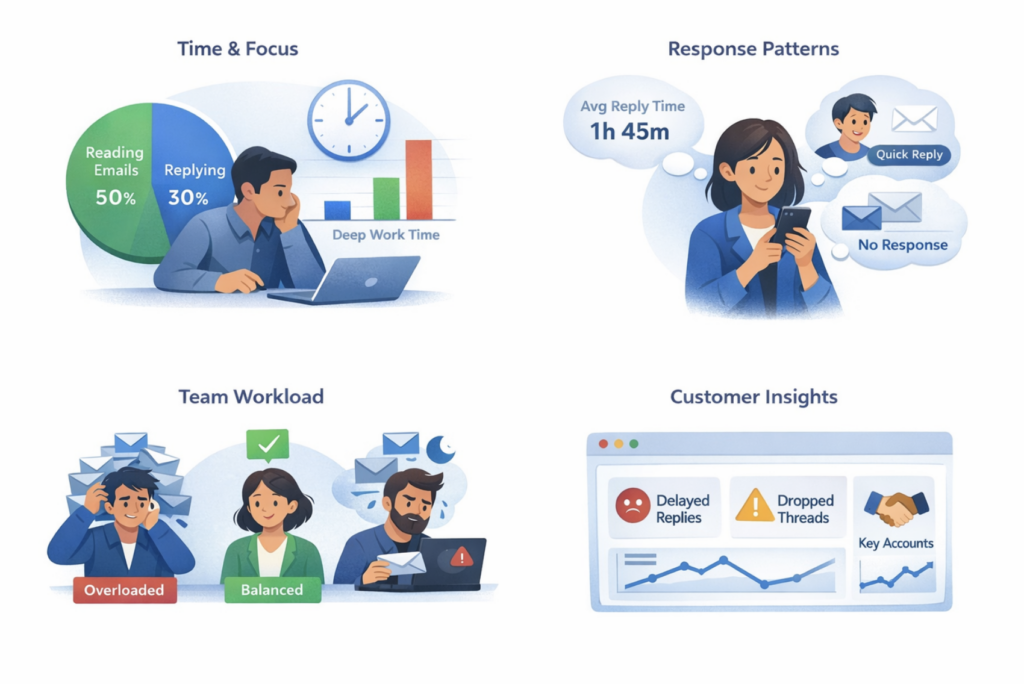
Email Analytics for Individuals: Clarity Over Control
For individuals, email analytics should feel like a mirror, not a report.
1. Time & Focus
- How much time you spend reading vs replying
- When email interrupts your deep work
- Which hours you’re most reactive
Many people assume email “just happens.”
Analytics makes it visible.
2. Responsiveness Patterns
- Average reply time
- People you reply to instantly vs delay
- Conversations that quietly die
Not to judge — but to understand habits.
3. Relationship Signals
- Who you interact with the most
- One-sided conversations
- Threads where effort isn’t reciprocated
This often explains stress better than inbox size.
4. Inbox Health
- Actionable vs FYI emails
- Noise vs real work
- Emails that never turn into outcomes
The goal isn’t inbox zero. It’s inbox intentional.
Email Analytics for Teams: Workflows, Not Surveillance
For teams, email analytics should never be about spying.
It should be about how work moves.
1. Load & Balance
- Email volume per role
- Overloaded teammates
- Hidden after-hours pressure
This surfaces problems early — before burnout.
2. Response & Flow
- First response times
- Internal delays vs external delays
- Threads stuck in loops
Most slowdowns aren’t personal. They’re structural.
3. Collaboration Signals
- Excessive CCs
- Long forwarding chains
- Too many people involved too early
Email shows process smells very clearly — if you look.
4. Customer & Partner Experience
- Dropped conversations
- Slow replies to key contacts
- Escalations that started small
Email analytics can quietly improve trust.
What Email Analytics Should Not Be
- ❌ Open-rate tracking
- ❌ Read receipts obsession
- ❌ Leaderboards
- ❌ Micromanagement tools
Those create anxiety, not improvement.
Good email analytics:
- Focuses on trends, not moments
- Explains patterns, not just numbers
- Helps people work better, not faster
The Real Value: Awareness → Better Decisions
Most professionals don’t need fewer emails.
They need better visibility into how email affects their work.
Once you see:
- where time leaks,
- where conversations stall,
- where attention gets hijacked,
You naturally change behavior – without forcing it.
That’s the real promise of email analytics.