ActorDo vs autonomous agents like OpenClaw
AI agents are getting more autonomous. OpenClaw (and it’s clones) are the most recent appearance related to AI agents that do things for you.
They can send emails, move files, book meetings, execute scripts.
Impressive? Yes.
Safe for business? Not always.
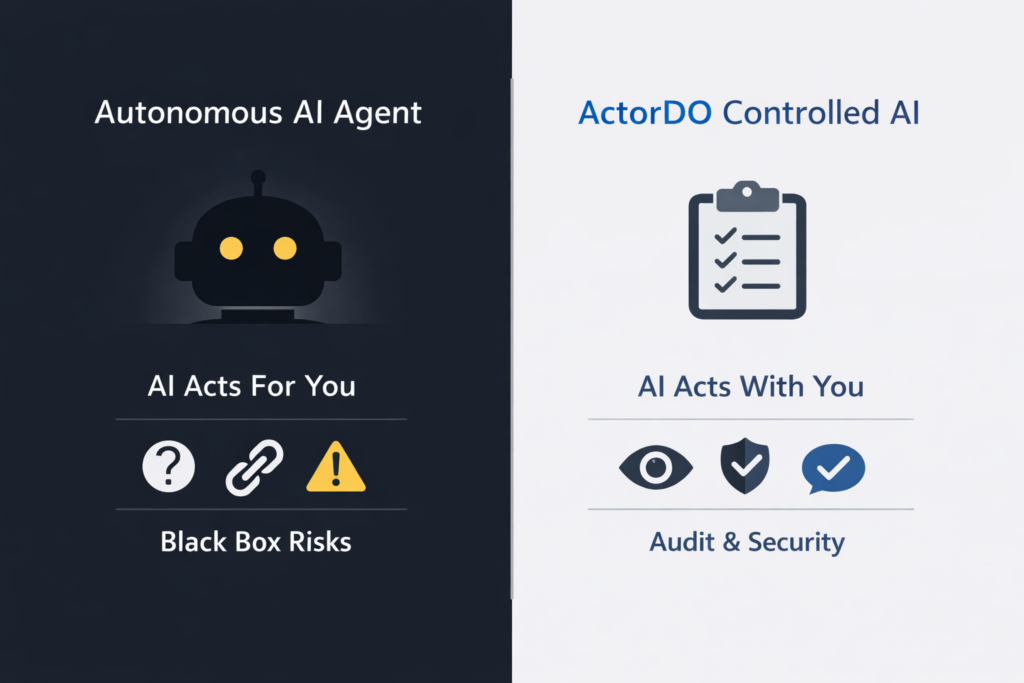
There’s a fundamental difference between autonomous AI agents like OpenClaw and ActorDO.
However we have to admit that a tool like OpenClaw it’s impressive in terms of flexibility, extensibility and the fact that can do things not already built in other assistants.
And it comes down to four things:
- Security
- Privacy
- Governance
- Business control
- Cost control
Let’s break it down.
Security: Black Box vs Controlled Execution
Autonomous agents are designed to act independently.
You give access. They execute.
The problem?
- They may trigger actions automatically
- They may access broad scopes
- They may chain decisions you didn’t explicitly approve
In business environments, that’s risky.
ActorDO takes a different approach:
- Clear execution boundaries
- Action logs
- Controlled scopes
- Human approval where needed
- No hidden automation chains
It’s not “AI running wild”, but it’s AI operating inside a controlled system.
Privacy: Data Ownership Matters
Many autonomous tools require:
- Full access to inbox
- Full file system permissions
- External hosting of sensitive data
- Broad API keys
ActorDO is built with privacy-first principles:
- Scoped integrations (Google, Microsoft, etc.)
- Clear data separation per user
- Controlled storage architecture
- Designed for regulated geographies and compliance contexts
- No hidden scraping or uncontrolled crawling
In business, privacy isn’t a feature, but needs to be part of the infrastructure.
Governance: Observability and Auditability
This is where the real difference shows. Autonomous agents optimize for “get things done.”
ActorDO optimizes for:
- Observability (you see what happened)
- Audit trail (who did what, when, why)
- Execution logs
- Action history
- Error traceability
- Permission layers
You can:
- Inspect decisions
- Review AI-generated actions
- Override
- Correct
- Stop execution
This is critical for:
- Finance teams
- Enterprise environments
- Compliance-heavy industries
- Growing startups
AI without governance becomes liability.
ActorDO is built as a governed AI system, not a free-running agent.
Business Focus: Productivity, Not Experimentation
Many open AI agents are general-purpose and they’re impressive engineering projects.
But businesses don’t need experiments.
They need:
- Structured email workflows
- Follow-up management
- Task extraction
- Calendar intelligence
- Predictable automation
- Clear ROI
ActorDO is focused on:
- Inbox clarity
- Action extraction
- Workflow automation
- Professional productivity
Not gaming the system.
Not browsing the web randomly.
Not running shell commands.
It’s AI built for professional operations.
Autonomy vs Control
Autonomous AI: “Let me handle everything.”
ActorDO: “Let’s handle this together – transparently.”
This is a fundamental philosophical difference.
ActorDO is:
- Control-first
- Security-first
- Governance-ready
- Business-focused
It’s not about replacing human judgment. It’s about augmenting it, safely.
Why This Matters in 2026 and Beyond
AI is becoming more powerful. We know this at Actor and we plan for it.
Which means:
- The risk surface increases
- Compliance requirements increase
- Data sensitivity increases
- Operational complexity increases
Companies won’t choose the most autonomous AI. They will choose the AI they can:
- Trust
- Audit
- Control
- Explain
That’s the difference. And that’s where ActorDO stands.
Full comparison between ActorDo and Autonomous AI Agents
| Dimension | Autonomous AI Agents | ActorDO |
|---|---|---|
| Core Philosophy | Autonomy-first (“AI acts for you”) | Control-first (“AI acts with you”) |
| Primary Goal | Execute tasks independently | Augment professional workflows |
| Decision Model | Self-directed chaining of actions | Structured, bounded execution |
| Execution Transparency | Often opaque or partial | Full visibility into actions |
| Observability | Limited logs or technical logs | Structured logs, action history, traceability |
| Audit Trail | Not always business-grade | Designed for auditability |
| Human-in-the-loop | Optional / minimal | Built-in control & review layer |
| Override Capability | Harder once triggered | Easy to review, modify, stop |
| Permission Control | Broad system/API access | Scoped integrations & controlled scopes |
| Security Model | Powerful but higher risk surface | Minimized blast radius design |
| Privacy Architecture | Often centralised or experimental | User-level isolation & structured data boundaries |
| Compliance Readiness | Rarely enterprise-ready | Designed for EU/Swiss business contexts |
| Data Governance | Weak policy enforcement | Structured governance layer |
| Role-based Access | Rare | Can be designed for business roles |
| Error Handling | Autonomous retry / chain behavior | Transparent failure & review |
| Explainability | May act without clear explanation | Traceable actions & reasoning paths |
| Predictability | Can be emergent/unexpected | Deterministic workflows |
| Setup Complexity | Technical & experimental | Business-focused onboarding |
| Target Users | Developers, AI enthusiasts | Professionals, founders, teams |
| Business Orientation | General-purpose | Email, tasks, workflow productivity |
| Risk Profile | Higher (broad autonomy) | Controlled & bounded |
| Scalability in Org | Harder to standardize | Structured for team adoption |
| Trust Factor | “Hope it works” | “Verify what happened” |
| Long-term Maintainability | Experimental evolution | Product-driven roadmap |
| Use in Finance / Compliance Industries | Risky | More suitable |
| Integration Philosophy | Deep system-level control | Controlled SaaS/API integrations |
| Failure Impact | Can cascade | Contained execution |
| Enterprise Adoption Readiness | Low | Medium → High (depending on implementation maturity) |
Future plans for ActorDo.
ActorDO is not anti-autonomy and we’re working for the future.
The direction is clear: the system will become more autonomous, more flexible, and more capable of handling multi-step workflows on its own.
But autonomy will not replace governance. As ActorDO evolves, it will maintain:
- Observability
- Audit trails
- Scoped permissions
- Human override
- Clear execution boundaries
The goal is not to remove the human from the loop. It is to reduce friction while preserving control.
In other words:
More intelligence and more automation.
Same transparency. Same governance. Same business-grade safety.
That balance is the long-term vision.