ClaudeWork vs ActorDo
I’m going to compare using ActorDo vs Claude to integrate and help you manage email, calendar and tasks automatically.
Overview of Claude vs ActorDo
ClaudeWork (agents) gives you raw power and flexibility. You can build an AI that plans, reasons, and executes across tools. But you carry the burden of orchestration, reliability, and control.
ActorDo (automations + agents underneath) trades some flexibility for structure. You get visibility, repeatability, and a system that behaves predictably across email, calendar, and tasks, with built-in workflows and channels like WhatsApp.
If you want to experiment and push boundaries, go Claude. If you want something that actually runs your daily work without breaking, go Actor.
Actor Studio is the strong bet we have for AI & Automations
ClaudeWork vs ActorDo
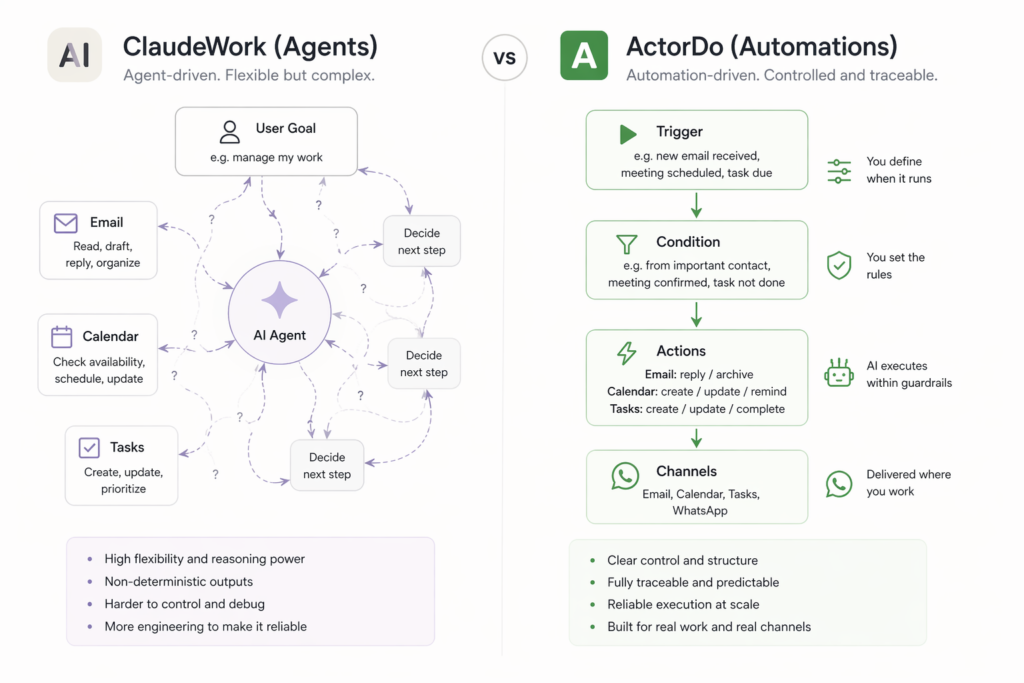
ClaudeWork represents the rise of agent-first systems. ActorDo represents automation-first systems powered by agents behind the scenes.
This difference looks small but changes everything in how work actually gets done.
That Claude Work actually is
Claude Work turns Claude into a digital coworker that can execute tasks, not just suggest them. It can read files, plan steps, and act across systems with minimal supervision
Under the hood, this is classic agent architecture
- perceive context
- plan steps
- call tools
- execute actions
Claude agents can dynamically discover and use tools, run multi-step workflows, and operate across environments
You can even push it to manage email, calendar, or tasks if you wire everything correctly. Some users already treat it like an executive assistant managing inbox and scheduling
So in theory, Claude can do everything.
In practice, that is where things get messy.
The hidden cost of agent-first systems
Agents are powerful because they are autonomous. They can activate, reason, and act without explicit step-by-step instructions
But that autonomy comes with trade-offs
No clear control layer
You rely on prompts, tool definitions, and orchestration logic. There is no native UI that shows what happens and why
Limited traceability
When something goes wrong, you debug reasoning chains, not workflows
Non-deterministic behavior
Same input can produce slightly different outputs. That is fine for writing, risky for operations
Engineering overhead
To manage email, calendar, tasks properly, you need to build
- integrations
- state management
- retries
- logging
- safety layers
Claude itself is not the system. It is the brain. You still need to build the body.
Even Anthropic positions it this way. Claude enables agents but developers must build orchestration layers and infrastructure around it
What ActorDo does differently
ActorDo flips the model
Instead of exposing agents directly, it exposes automations
- triggers
- conditions
- actions
Behind the scenes, agents still exist. But they are constrained inside structured workflows.
This gives you something Claude alone does not
Control
You define exactly when something runs and what it does
Traceability
Every automation has a visible flow. You can see what happened and why
Repeatability
Same input leads to same outcome. No surprises
Operational reliability
You are not debugging prompts. You are managing workflows
This matters a lot for email, calendar, and tasks, where consistency beats creativity.
Agents vs Automations in Real Workflows
Email management
Claude approach
You build an agent that reads emails, decides what to do, drafts replies
Problem: You need to trust its reasoning every time
ActorDo approach
You define
- when email arrives
- what conditions apply
- what actions happen
The AI helps with decisions, but inside guardrails
Calendar and scheduling
Claude
Agent analyzes availability, sends proposals, follows up
Powerful, but fragile if logic is not perfect
ActorDo
Predefined flows for
- booking
- reminders
- follow-ups
AI enhances, not replaces structure
Tasks and execution
Claude
Agent decides what tasks exist and how to act
ActorDo
Tasks are extracted, tracked, and executed through structured flows
Less magic, more reliability
Where Claude Work wins
There are real advantages
Maximum flexibility
You can build anything. No constraints
Deep reasoning
Agents can adapt to complex, undefined problems
Cross-domain execution
One agent can move between tools, files, systems
Rapid experimentation
Great for testing new workflows or ideas
If you are building a system or exploring edge cases, this is unmatched.
Where ActorDo wins
This is where things shift in real usage.
Operational clarity
You see workflows, not black-box reasoning
User control
You decide what runs automatically and what requires confirmation
Traceability
Every action is logged and explainable
Multi-channel execution
Built-in delivery like WhatsApp, not just APIs
Time to value
No need to build infrastructure just to make email automation work
ActorDo is not trying to be smarter than Claude
It is trying to be usable every day
The real trade-off
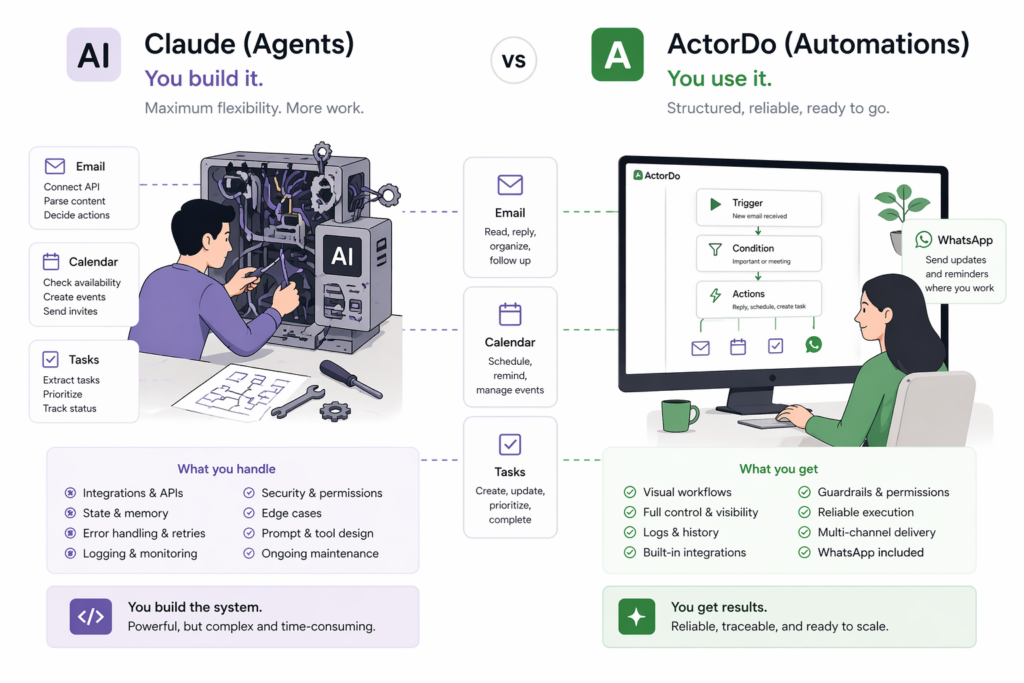
Claude Work
You are building an AI system
ActorDo
You are using one
That is the core difference
Claude gives you raw intelligence
Actor gives you applied intelligence
The practical decision
Use ClaudeWork if:
- you want to build your own agent system
- you need full flexibility
- you are ok with engineering complexity
Use ActorDo if:
- you want something that works today, not after weeks of setup
- you want reliable execution across email, calendar, tasks
- you care about visibility and control